Showing posts with label blackberries. Show all posts
Wednesday, 1 October 2014
Blackberry tea loaf
I've been a bit slow in posting this, but back at the beginning of September I made this delicious tea loaf as a way of baking with blackberries while they were still in season. The recipe comes from the National Trust "Teatime Baking Book" by Jane Pettigrew and along with the blackberries, lemon and black treacle help to give this loaf a lovely deep flavour. A yummy teatime treat I will definitely be making again next year.
Incidentally, the National Trust has a variety of recipes available on its website. Among the recipes ideas for puddings and cakes is one for a blackberry and apple upside-down cake. The blackberries may be over, but I have just come back from Herefordshire with a bag of hand-picked Bramleys (courtesy of the P's) and an apple upside-down cake sounds a very appealing idea...
Saturday, 9 August 2014
Have blackberries, will make jam
It's that time of year again and I have a wonderful abundance of blackberries at the bottom of my garden, so I made some time last weekend to make some jam.
Having had the experience of making jam for the first time last year, I felt a lot more confident about it this year; hopefully I had learnt from last year's mistakes! Plus, I now had a jam thermometer to help me (a Christmas present I was looking forward to trying out).
I picked about 700g of fruit; to this I added about 900g of jam sugar. Note to self: pick less fruit next time or get a bigger pan!


The jam thermometer makes the process so much easier, as it takes away the element of uncertainty. I have to admit I still did use the "plate" test (putting a small drop of the hot mixture onto a cold plate to see whether it sets when cool), but this was simply a consistency check measure.
I am really pleased with the colour and consistency of the finished jam; I think it is a little too sweet and so I think with the next batch I will use less jam sugar - although it will be interesting to see how this affects the cooking process, as blackberries are a low-pectin fruit and so with this batch I used more sugar-to-fruit to counter this (jam sugar contains added pectin). Watch this space...
Sweetness aside, I can confirm that there is a sweet(!) enjoyment in having your own homemade jam spread on your toast for breakfast; a very satisfying way to start any morning.
Having had the experience of making jam for the first time last year, I felt a lot more confident about it this year; hopefully I had learnt from last year's mistakes! Plus, I now had a jam thermometer to help me (a Christmas present I was looking forward to trying out).
I am really pleased with the colour and consistency of the finished jam; I think it is a little too sweet and so I think with the next batch I will use less jam sugar - although it will be interesting to see how this affects the cooking process, as blackberries are a low-pectin fruit and so with this batch I used more sugar-to-fruit to counter this (jam sugar contains added pectin). Watch this space...
Sweetness aside, I can confirm that there is a sweet(!) enjoyment in having your own homemade jam spread on your toast for breakfast; a very satisfying way to start any morning.
Monday, 30 September 2013
Jam making
I promised to share with you my jam-making exploits, so here goes.
Of the many joys moving into a new house brings, discovering the garden and all the varied things it has to offer over the course of the year is one of the most interesting, and the one that usually brings the more pleasant surprises. One of my happiest discoveries has been that I only need venture to the bottom of my garden to forage for blackberries.
I decided that it was time I did something with these blackberries. Never having made jam before, I thought this would be a good opportunity to try. However, blackberries are a low-pectin fruit so need some assistance when it comes to getting a good set on your jam. I read that a good trick is to add a few squeezes of lemon juice to the fruit before you start the heating process. As ever, Mother was on hand with advice, and suggested I combine the blackberries with apples, which are a high-pectin fruit.
Attempt #1
For my first attempt I used apples from the garden. I used equal amounts of blackberries and apples, and matched the combined weight of the fruit with granulated sugar.
It started out promising, but because the apples were eaters not cookers, they didn't dissolve. Never mind I thought, I'll strain the mixture and make a blackberry and apple jelly (apparently it's a jelly if it's strained). Not having a jam thermometer, I used the cold plate test to try to judge when the mixture was ready.
The cold plate test involves putting a drop of the mixture onto a cold plate (pop in the fridge or freezer), letting it cool and then gently pressing from the side with your little finger; if the jelly wrinkles it's ready to set.
Unfortunately I didn't really know what I was looking for, and overcooked it. The result, when it cooled, was a very sticky mess at the bottom of the jar! Not wanting to throw it away I put it in the fridge anyway, and I'm glad I did. In a lesson that most things are salvageable, Maud helpfully advised that I could reheat the mixture with some extra water. The result of this was a much more pleasing, and edible, set jelly. It is rather sweet, probably because I used eating apples (which are sweeter than cooking apples).
Attempt #2
A definite improvement. This time I limited myself to blackberries. I used equal weight of blackberries and granulated sugar.
Having overcooked once before, I had a better idea of what consistency I was looking for to know whether the jam would set. When doing the cold plate test you're not looking for wrinkles so much as signs of a skin forming on the top. Basically when the jam on the plate cools, ask yourself whether it is the right consistency for putting on a scone. If the answer is yes, your jam is done! And a good tip from Maud: don't forget to take your pan off the heat while doing the cold plate test, or your jam mixture will carry on cooking!
I was really quite proud of my second attempt. It tastes rather good, even if I do say so myself, and went very well some homemade scones.
Attempt #3
Mother gave me some Bramley apples from her garden, so I thought I would try blackberry and apple again. This time I cut the apples up a lot smaller, and being cooking apples they dissolved (which meant no need to strain). I used equal weights of blackberries and apples.
For this attempt I used jam sugar, my first time using this. Jam sugar has pectin added to it, and so helps with the setting process. As apples are high in pectin I used slightly less sugar than the combined weight of the fruit.
The result is not as sweet as the first, and I prefer it for this. It has quite a firm set, but my no means is this too much. In all, a successful first attempt with jam sugar.
It's going to take a lot of scones for me to get through all this jam...
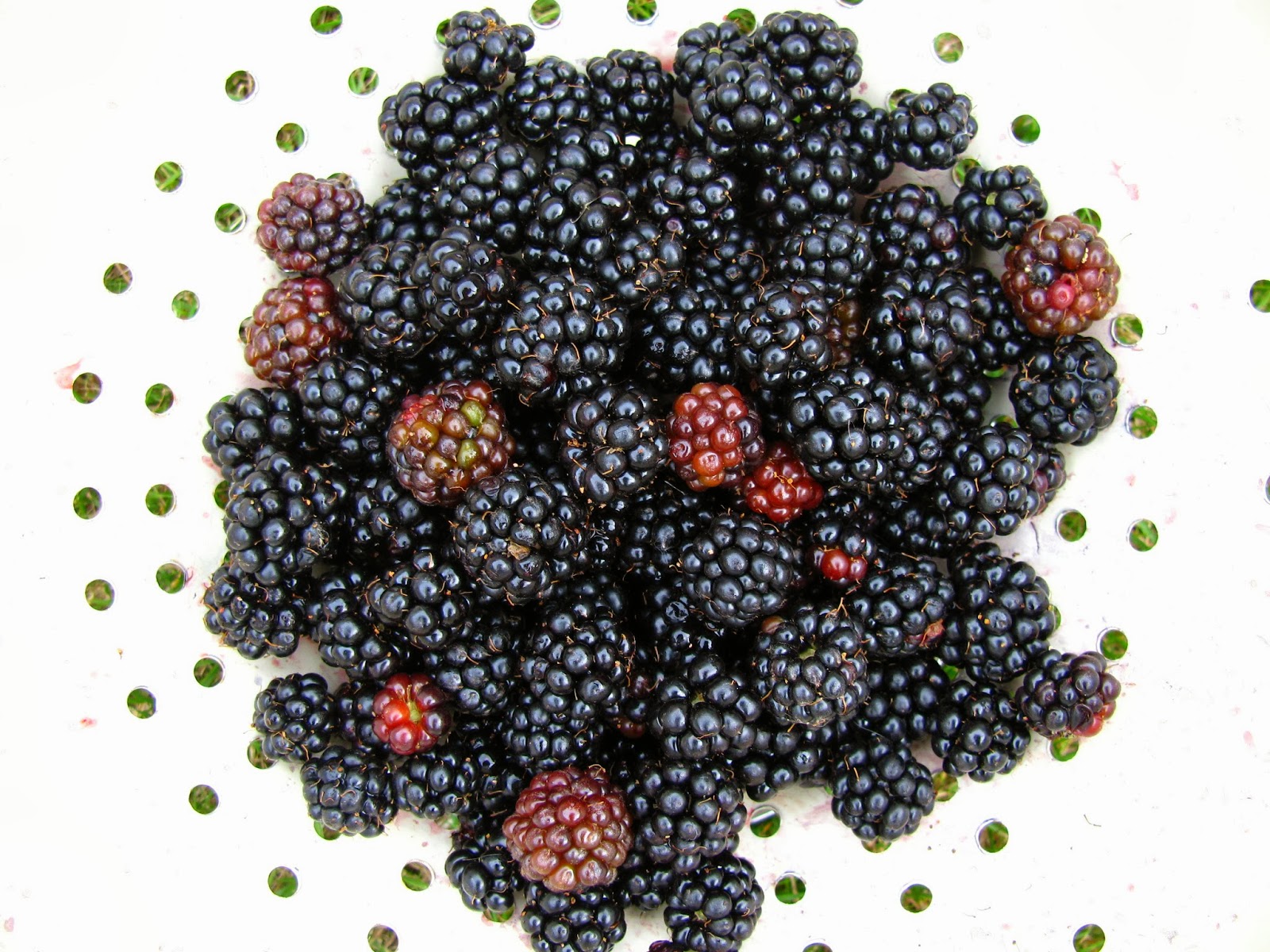
| The less ripe berries are higher in pectin and so it is a good idea to include a few of these |
Attempt #1
For my first attempt I used apples from the garden. I used equal amounts of blackberries and apples, and matched the combined weight of the fruit with granulated sugar.
It started out promising, but because the apples were eaters not cookers, they didn't dissolve. Never mind I thought, I'll strain the mixture and make a blackberry and apple jelly (apparently it's a jelly if it's strained). Not having a jam thermometer, I used the cold plate test to try to judge when the mixture was ready.
The cold plate test involves putting a drop of the mixture onto a cold plate (pop in the fridge or freezer), letting it cool and then gently pressing from the side with your little finger; if the jelly wrinkles it's ready to set.
Unfortunately I didn't really know what I was looking for, and overcooked it. The result, when it cooled, was a very sticky mess at the bottom of the jar! Not wanting to throw it away I put it in the fridge anyway, and I'm glad I did. In a lesson that most things are salvageable, Maud helpfully advised that I could reheat the mixture with some extra water. The result of this was a much more pleasing, and edible, set jelly. It is rather sweet, probably because I used eating apples (which are sweeter than cooking apples).
Attempt #2
A definite improvement. This time I limited myself to blackberries. I used equal weight of blackberries and granulated sugar.
| Early on in the cooking process |
I was really quite proud of my second attempt. It tastes rather good, even if I do say so myself, and went very well some homemade scones.
Attempt #3
Mother gave me some Bramley apples from her garden, so I thought I would try blackberry and apple again. This time I cut the apples up a lot smaller, and being cooking apples they dissolved (which meant no need to strain). I used equal weights of blackberries and apples.
For this attempt I used jam sugar, my first time using this. Jam sugar has pectin added to it, and so helps with the setting process. As apples are high in pectin I used slightly less sugar than the combined weight of the fruit.
The result is not as sweet as the first, and I prefer it for this. It has quite a firm set, but my no means is this too much. In all, a successful first attempt with jam sugar.
It's going to take a lot of scones for me to get through all this jam...
| This is my second attempt and is a simple blackberry jam. |
Subscribe to:
Comments (Atom)